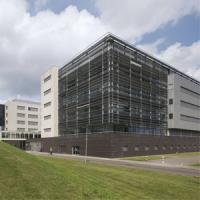
MERLN — Institute for Technology-Inspired Regenerative Medicine
The MERLN Institute for Technology-Inspired Regenerative Medicine strives to maintain a leading position in the field of biomedical engineering by combining creative research with training a generation of interdisciplinary scientists. MERLN’s activities operate at the interface of biology, engineering and medicine to maximise impact at the level of public involvement and the commercialisation of research. MERLN’s vision is based on sharing knowledge, infrastructure, and ambition.
Scientific Breakthrough
MERLN Develops the First Model for Monozygotic Twinning Scientists at Maastricht UMC+ and the MERLN Institute have succeeded in growing an embryo structure of human identical twins purely from stem cells, bypassing the need for egg or sperm cells. This advancement makes it possible, for the first time, to glimpse into the processes of how identical twins form: accelerated expansion of the blastocyst—a type of sac made of placenta cells that contains the stem cells in it from which new life emerges—splits the embryo into two. This new scientific achievement has been published in the renowned scientific journal Advanced Materials (Dorian Luijkx et al.) and is the result of a technological platform which for several years has been unravelling increasingly complex biological secrets, enabling the controlled growth of cells, tissues, organs and embryos. The current research initially focuses on the healthy implantation and development of embryos. The synthetic embryos make it possible to study the first crucial micro-processes, which previously remained hidden in the womb. The aim is to use this research to make improved biomedical care accessible and affordable on a large scale.

Research
Research at MERLN is focused on developing and employing breakthrough technologies to advance the repair and regeneration of both tissues and organs. The strategy includes, amongst others, the development of “smart” biomaterials that can trigger intrinsic tissue repair mechanisms mediated by the patient’s own cells.
Education
MERLN’s scientists are involved in educational activities within different undergraduate and graduate programmes as well as in the supervision of students performing research projects. They use their expertise in biology, chemistry, materials science and engineering, with distinct emphasis on biomedical applications, including regenerative medicine.

Lorenzo Moroni
“Our overarching goal is to create new solutions for regenerative medicine and understand the fundamental phenomena at the base of the observed regenerative processes.”

Roman Truckenmüller
"Intelligently designed synthetic biomaterials that can regulate the regeneration of damaged organs and tissues in the body are the future of regenerative medicine. Indeed, we need creativity in materials science and engineering to make regenerative strategies affordable for everybody."

Martijn van Griensven
“Our research aims at further developing and innovating a competitive research line including translational aspects in the field of molecular and cellular regenerative medicine.”

Sabine van Rijt
“Intelligently designed synthetic biomaterials that can regulate the regeneration of damaged organs and tissues in the body are the future of regenerative medicine. Indeed, we need creativity in materials science and engineering to make regenerative strategies affordable for everybody.”


A Brightlands institute
Brightlands is an open innovation community in a global context, connecting four campuses in the province of Limburg: in Maastricht, Heerlen, Sittard-Geleen and Venlo. The campuses provide entrepreneurs, scientists and students state-of-the-art facilities to support development, education, innovation and growth. Naturally, there are close links between all four Brightlands campuses, and together they enable Limburg to serve as an innovation region where researchers and entrepreneurs take on the major challenges in the areas of materials, health, food and smart services.