Between nuance and news: Bringing Europe closer to Limburg
In a time when news spreads at lightning speed and opinions sometimes sound louder than facts, the importance of interpretation and context is growing. What do global events mean for people in the region? And how do you translate complex academic knowledge into a clear story for a broad audience?
For presenter Maurice de Heus of L1 and Professor of EU External Democracy Promotion Giselle Bosse, that is exactly the challenge that makes their collaboration so interesting.
When Europe meets the region
The idea for a programme offering European context arose from a simple observation, Maurice explains. “The situation in Eastern Europe, the war in Ukraine, but also tax issues or projects like the Einstein Telescope – they are all connected to Europe and directly or indirectly relevant for our border region,” he says. “That’s why we wanted to create a programme where we could discuss these kinds of themes.”
This led to the L1 programme Avondgasten Europa, in which developments in Europe are discussed with an eye on what they mean for Limburg. Topics range from geopolitics to industry and education: from the future of VDL Nedcar to the role of universities and students in a European context.
But for that deeper perspective Maurice needed someone who not only followed the news but could also place it in context. Giselle turned out to be the right person. “As a journalist you often know a little about a lot,” Maurice explains. “But Giselle knows a lot about a specific topic. As a regional broadcaster, that’s exactly the kind of depth and interpretation we want to offer.”
Studying Europe’s Eastern neighbours
That expertise does not come out of nowhere. Giselle is a political scientist and has spent more than two decades researching the foreign policy of the European Union, with a particular focus on EU enlargement and the EU’s democracy support in Eastern Europe. In her work, she examines how the EU engages with countries such as Ukraine, Georgia, and Armenia, and how it seeks to support democracy, the rule of law, and stability in the region.
While this may at first appear abstract, recent developments have rendered Giselle’s research strikingly tangible. “Many of the questions I have been working on for years are now in the news every day,” Giselle says. “Russia’s war against Ukraine has underscored just how important that region is for the EU.”
For a regional TV programme in Limburg, this might initially seem somewhat distant. Yet, according to Giselle, the opposite is true. “What happens in the world inevitably has consequences for the region,” she says. “Think of energy prices, security, industry, or European politics. These dynamics are closely interconnected.”
The art of leaving things out
For Giselle, translating complex geopolitics for television may be the greatest challenge. “Actually, I often know too much,” she says with a laugh. “So I tell Maurice: you decide what we’re going to discuss.” As a researcher, she is used to analysing complex topics thoroughly and with nuance. But television works differently. “You don’t want to oversimplify, but you also want people to be able to follow it. During preparation I often think: this could be a bit shorter. But even then it is sometimes still too long.”
Still, she sees it as a valuable exercise. “In academia much of our work is published in specialised scientific journals. Yet universities don’t only fulfil educational and research functions; they also carry a broader public responsibility.” According to Giselle, contributing to public debate is part of a university’s role. “The university is still a public institution. Informed public debate is extremely important for democracy.”
Both researchers and journalists play a role in that. “Journalists and media are essential for stimulating that discussion,” Giselle says. “As researchers, we strive to be independent and express views firmly grounded in evidence. This lends a particular form of authority – and especially at a time when public debates are often highly emotional, that role becomes all the more important. In the end, both media and science contribute to democracy.”

Bite-sized news versus deeper context
Journalism and academia, however, operate according to different logics. “Journalists are often looking for bite-sized information,” Maurice says, “whereas in academia you want to place everything in perspective.” That difference is often simply due to practical limitations. “As a journalist you have little time and few words,” he explains. “You have to get to the point quickly.”
Giselle also sees that difference. “We fulfil different roles in society and within a democratic system,” she says. “Independent media are just as important as independent research. But we operate differently.”
Precisely for that reason, collaboration can be valuable. “Journalists play a crucial role in translating scientific knowledge,” she says. “In an ideal world, science and media work closely together.” Where researchers may at times be more removed from everyday concerns, journalists are often more closely attuned to them. “As a researcher it can be difficult to assess what occupies people’s minds,” Giselle says. “Journalists have a much clearer sense of that. That exchange is what makes the collaboration so valuable.”
For Maurice, one of the most important skills of a journalist is recognising the limits of one’s own knowledge. “The key is knowing what you don’t know,” he says. “That’s where it starts.” The challenge often lies in finding balance. “As a journalist you want a black-and-white story, but in reality it is always grey. And that grey story has to be told as clearly as possible.” That means making choices. “You have to distinguish the main issues from the side issues.”
The boundary of independence
For researchers, media attention is not without risks. “There can sometimes be a temptation to become more activist or to seek out controversy,” Giselle says. “But as a researcher you have to be very careful with that.” According to her, the strength of academic work lies precisely in its independence. “Our authority comes from the fact that we do not choose one side. You have to present different perspectives so that viewers or listeners can form their own opinions.”
In that respect, the logic of science does not always align with that of journalism. “Journalists may keep asking questions until they obtain that one quote they are looking for,” she says. “They are searching for a punchline. And sometimes you then see something in the newspaper that looks quite different from what you thought you had said.”
Maurice recognises this but adds nuance. “I am also looking for a punchline,” he says, “but one that is correct.” That is why a broadcast is always carefully prepared. “We discuss beforehand what the conversation might cover, who else will be at the table, and which topics may come up.”
Public broadcasting in an age of distrust
According to Maurice, cooperation between science and journalism is becoming increasingly important due to changing societal trends. “In the United States you see growing scepticism towards science and ‘the elite’,” he says. “That is dangerous, and it is also drifting over to Europe.” He believes this creates a clear role for public broadcasters. “We have to continue presenting the relationships properly. Putting science into perspective and keeping it relevant.”
But public broadcasting itself is also under pressure. “There is a lot of criticism of it,” Giselle says, “and that is a very concrete challenge for democracy.” Still, Maurice believes that this is precisely where their task lies. “Our role as a public broadcaster is to translate science for ordinary people. People should be able to think: what do I actually gain from the university?”
According to Giselle, that translation can help restore a place for facts in public debate. “Public broadcasting still remains close to people,” she says. “And sometimes it can encourage individuals to reconsider their views – for example when they have been drawn into conspiracy narratives through social media.”
That captures the core of the collaboration between journalists and researchers: a shared effort to create a space in which nuance can endure – even in an age dominated by rapid headlines. Somewhere between bite-sized information and academic depth, something new emerges: a conversation that not only informs, but also invites people to think further. Exactly what a healthy democracy needs.
By: Eva Durlinger
Photo by: Claire Gilissen
Also read
-
Discover how FASoS research is making an impact beyond academia in the newly published annual research report 2025
Through inspiring interviews and research highlights, the report explores topics ranging from children’s digital lives and environmental heritage to European politics and community engagement through film.Researchers
-
Marlies Vermeulen first MERIAN PhD to defend her artistic research
In her research practice she radically explores how to learn to become a cartopologist. Her work combines anthropological, architectural and cartographical methods to create unique maps of places.Researchers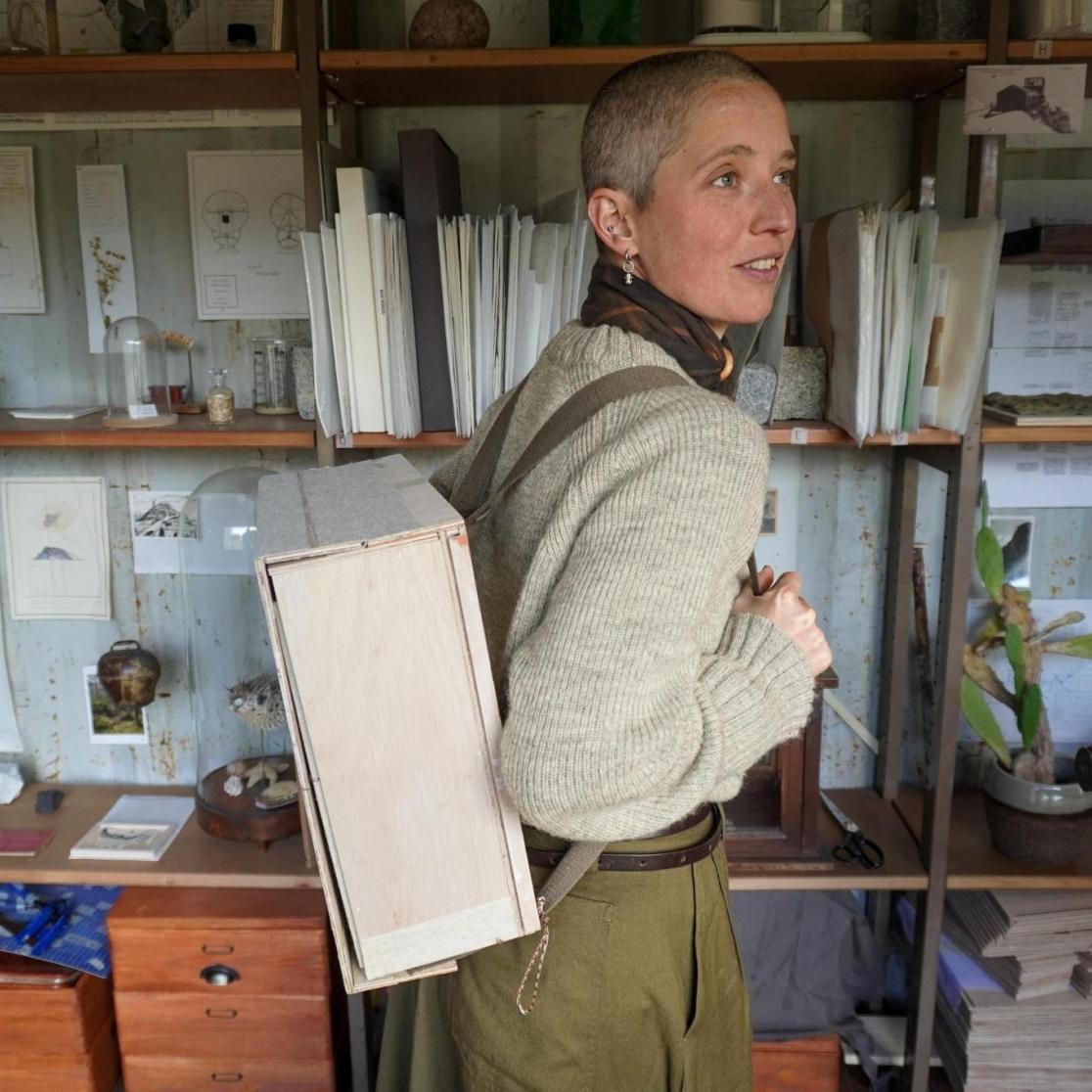
-
Maastricht strengthens position as hotspot for artistic research
With a joint learning environment for art and research in Maastricht, artistic research network MERIAN is taking the next step in the development of the art sectorResearchers